
AI 3D weapons that your characters can actually hold
A weapon is two problems: the model, and getting it into a hand at the right size and angle. asset mesh <item> --held makes the weapon alone and finds where it is gripped. asset attach then puts it in a rigged character’s hand, with clips made for that kind of hold. The knight on this page holds a sword made this way, and the golem holds an axe.
npm install -g @tyrbo/assetMake a key in the Tyrbo app, then run asset login. Add --mock to try any command free first.
The commands
asset look meadow "bright cel-shaded fantasy village" --view isometric
asset mesh knight "a knight in plate armour and a blue tabard" --rig biped
asset mesh sword "a steel longsword with a leather-wrapped grip" --held
asset attach knight sword
asset mesh buckler "a round oak buckler with an iron rim" --held --hold shield
asset attach knight buckler
Made by the CLI, not drawn for this page
Real files the asset CLI wrote, each under the command that made it.
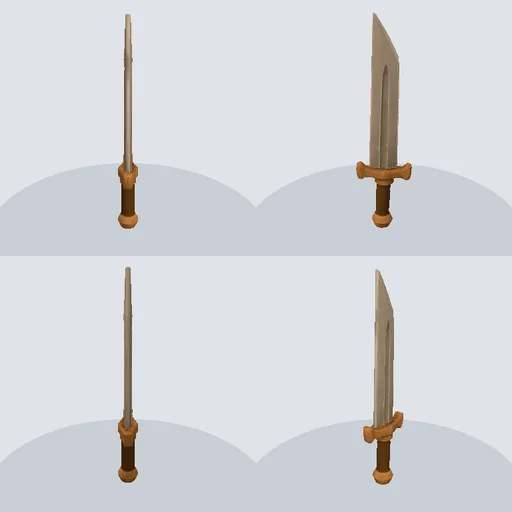
asset mesh sword "…" --held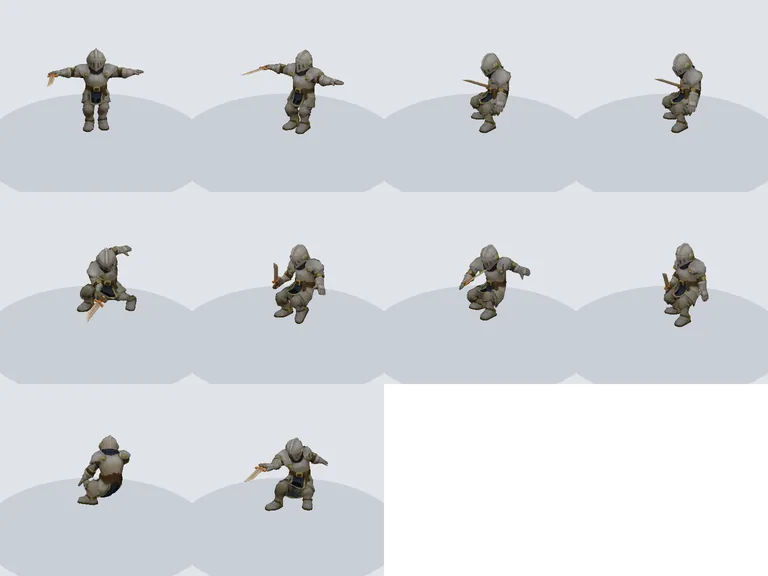
asset attach knight sword
asset attach dwarf axe
asset attach paladin swordWhy characters are made empty-handed
When a character's words mention a sword or a staff, its design is still drawn with both hands empty, on purpose, and the result tells you how to make the item. A weapon sculpted into a fist cannot be swapped, dropped or upgraded. Kept apart, one knight can carry a sword in one level and an axe in the next, and every weapon in your game is its own small file.
How the grip is found
With --held, the item is drawn standing the way its hold draws it, then sculpted like any model. Code reads the grip off the sculpt:
- a sword or a staff: the middle of the thin stretch at its foot
- a gun: the handle between its butt and its frame
- a bow: half way up its stave
- a shield: behind the middle of its face
The model is moved so that grip is its origin, with its edge or muzzle facing forward, and scaled to a share of its holder's height: a sword half, a dagger a fifth, a staff the whole. --length on asset attach sets another share.
Five holds and the clips each brings
The hold comes from the item's words, or --hold picks it: blade, shield, gun, bow or staff. Each brings clips from the library:
- blade, right hand: sword-idle, sword-attack, sword-block, sword-light-combo
- shield, left hand: idle-shield-loop, shield-oneshot, shield-dash, sprint-shield-loop
- gun, right hand: pistol-idle-loop, pistol-aim-neutral, pistol-shoot, pistol-reload
- bow, left hand: bow-aim-neutral, bow-notch, bow-shoot, bow-rapidshoot-loop
- staff, left hand: idle-torch-loop, spell-simple-idle-loop, spell-simple-shoot, spell-simple-enter
Not in the library yet: a two-handed swing for a greatsword or a hammer, a rifle held in both hands, and a spear's thrust.
In the hand, frame by frame
asset attach hangs a socket at the palm and fixes the item there, rigid, never skinned, so when a clip turns the wrist the blade turns with it. It is free, and it writes a picture, knight-sword.png, of the item held at rest and through its clips, the way the key frames on this page were made. Attach another item to the same hand and both stay in the file, so your game shows one and hides the rest by name.
Questions people ask
Can I use a weapon as a prop on its own?
Yes. The item is a normal .glb with its texture inside, so it can lie on a rack or in a chest. Its grip at the origin also makes it easy to place in a hand of your own rig.
What if it guesses the wrong hold?
Name it with --hold, for example --hold staff for a long wand the words left unclear. --hand left on asset attach moves the item to the other hand, which takes no clips of its own.
Does a two-handed axe work?
It can be made and held, but the clips swing it in one hand. A two-handed swing is a clip pack still to add.
Install it, then ask for the look.
Get an asset keyMake a key in the Tyrbo app, then run asset login. Add --mock to try any command free first.